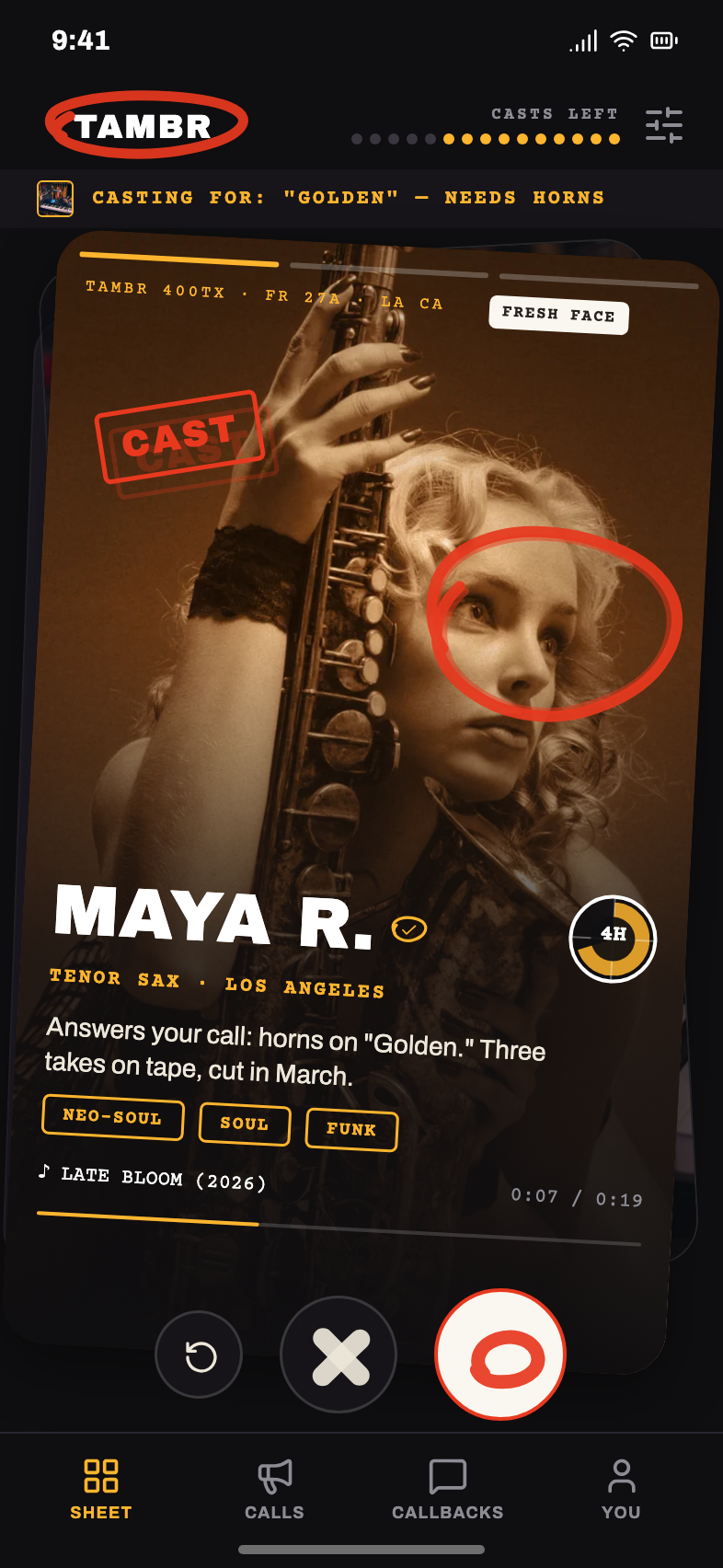
You post the song and say what it is missing. We show you people who could play it, one at a time, with their sound already playing. Swipe right and that is a real offer with real money or real points on it. They swipe back and the paperwork signs itself.
you never swipe on a person. you swipe on a person against a brief.
That single change fixes what kills every swipe marketplace. Rank by relevance to this song instead of global popularity, cap the caster at fifteen swipes per call, and make the swipe carry money. The abundant side cannot spam, because the swipe that matters has a price on it.
Horns on this. A lyricist. Someone to sing the hook. Key, BPM, reference, deadline. No call can be posted without terms attached, so "exposure" never appears in the interface.
Ten to twenty players who fit that brief, never an infinite pool. Sound on by default, opening on the hook. The clip that plays is the one relevant to your song, so the audio is the decision and the photo is only the hook.
Right swipe sends the offer with the terms already on it. They accept or counter once. Accept signs the split sheet, cash goes to escrow, and the project room opens.
Picking a side flips the feed, the button and the notifications, so it behaves like a mode rather than a setting. Most working musicians pick both.
The deal type gates every field after it, so this is a branching wizard and never a long form. Ambiguity about credit and stems is the number one grievance after a session, so the free option spells all three out.
Credit on the release, stems for their reel, and the right to post sixty seconds. Three explicit toggles, because "I'll credit you" means nothing.
One figure, agreed before anyone swipes. The player is quoted $400 and the caller is charged $440, so the ten percent never comes out of the take. Held in escrow at match, released on delivery, auto released fourteen days later if the caster goes quiet. Work for hire by default, said in plain English.
Composition and master shown separately, always, because conflating them is where litigation starts. IPI and PRO are blocking fields. No IPI means the money sits unmatched at the MLC.
| Role | Market range | Default offer |
|---|---|---|
| Vocalist | $75 to $1,500+ | $250 |
| Horns and strings | $75 to $900+ | $200 |
| Guitar, bass, drums | $50 to $800+ | $175 |
| Topline writer | $150 to $1,000+ | $300 |
| Mixing engineer | $100 to $2,500 | $400 |
The app runs on film black so the faces and the money are the only lit things in it. Amber edge print, a red grease pencil that circles a face the way a casting director marks a contact sheet, and a swipe budget you can count at a glance. Paper appears on exactly four screens, the ones where you sign something, and the switch to white is the point.
SoundBetter's own pagination gives the count. Players are not merely abundant, they are glutted, so every dollar goes to acquiring people who have a finished song, a budget, and a hole in it.
The Tinder sorority move. Players are easy to recruit and the stack has to be full before a caster ever opens it.
The DoorDash move. Match the first fifty calls manually, one at a time, before any algorithm exists.
The Airbnb photography move, applied to language. A vague call is the churn mechanism, so nobody sees one until it has been rewritten.
They solved the introduction and never built the transaction. Vampr had the swipe, the audio profiles and 1.4 million users, then sold for under three million dollars. Demand is not the question. Musicians already pay each other through Reddit, Discord and a freelancing site built for web developers.